
Airbnb Says Your Philadelphia License Isn't Verified? Why Compliant Hosts Now Earn More
If you host in Philadelphia, you may have opened Airbnb recently and seen a message telling you to contact the City because your license wasn't verified. You're not alone, and it doesn't always mean your license is invalid.
Philadelphia has stepped up how it checks short-term rental listings. Here's what changed, why listings get flagged, and what you can do about it this week.
Quick answer
Why is Airbnb saying my Philadelphia license was not verified? Since 2026, Airbnb and other platforms report every Philadelphia listing's address, host name, license type, and license number to the City's Department of Licenses and Inspections (L&I) every month. If the City's records don't match your listing (wrong license type, wrong number, unit mismatch, more listings than licensed units, or an inactive license), Airbnb asks you to update your license. Owner-occupied hosts need a Limited Lodging Operator License; non-owner-occupied hosts need a Rental License with a hotel designation plus Visitor Accommodations zoning. Ramblei, a Philadelphia short-term rental management company, helps hosts check eligibility, fix license mismatches, and switch to mid-term rentals when a property can't qualify.
What changed: the City now checks every listing, every month
Under Philadelphia Code § 9-3910, booking platforms like Airbnb and VRBO must hold a Limited Lodging and Hotels Booking Agent License and report booking data to the Department of Licenses and Inspections (L&I). L&I recently amended its regulations so those reports are due monthly instead of quarterly.
For every Philadelphia listing with a completed booking, the platform reports:
The host or operator name
The license type, license number, and rental license category
The street address, including the unit number
L&I's reporting rules are strict: one listing, one address, one license number per row, and each license must match the property it was issued for. The first report under the new schedule covered July through September 2026 and was due October 31. If you got a notice in early November, that timing is probably not a coincidence.
Philadelphia's short-term rental market right now (fall 2026)
Philadelphia's short-term rental market is getting stricter and more crowded at the same time. Licensed hosts who play by the rules are in a stronger position than they were a year ago.
Plenty of listings, few licenses. AirROI tracked about 4,590 active Airbnb listings in Philadelphia over the 12 months to October 2026. By comparison, the City shows only about 594 active Limited Lodging licenses (as of October 16, 2026) and roughly 450 active hotel-category rental licenses.
About one in three listings has a license problem. In June 2026, the City Controller reviewed 3,734 Airbnb listings and found 1,327 with inactive, expired, or ineligible licenses. The Controller also recommended the City use outside firms that automatically match booking-site listings against City records.
Enforcement is now monthly. Platforms now report every Philadelphia listing to L&I each month instead of each quarter, so mismatches surface faster.
New neighbor-notice rules. A law signed June 23, 2026 (Bill No. 260241), effective August 22, 2026, requires licensees to notify the building owner and residents in writing, and requires landlords of multi-family buildings to disclose in leases whether limited lodging is licensed.
Big events lifted prices more than bookings. During the 2026 FIFA World Cup, Philadelphia short-term rental revenue reached $38.3 million, up 25% from the same period a year earlier, but almost all of the gain came from higher nightly rates. Occupancy actually fell as new supply outpaced demand (AirDNA data reported by the Philadelphia Inquirer).
Typical numbers. AirROI puts the median booked nightly rate at about $145 and average annual revenue per listing at about $25,300. About 19% of Philadelphia listings already require stays of 30 nights or more, a sign many hosts have shifted to mid-term rentals.
Taxes held steady. A proposed increase to short-term rental and hotel taxes was left out of the City's fiscal 2027 budget in June 2026, so the total hotel tax on a stay remains 15.5%.
Spotlight: in University City, a licensed short-term rental is worth more than ever
Our own analysis of AirDNA and Airbnb data for University City (November 2025 to October 2026) shows how far the shift to 30+ night stays has gone:
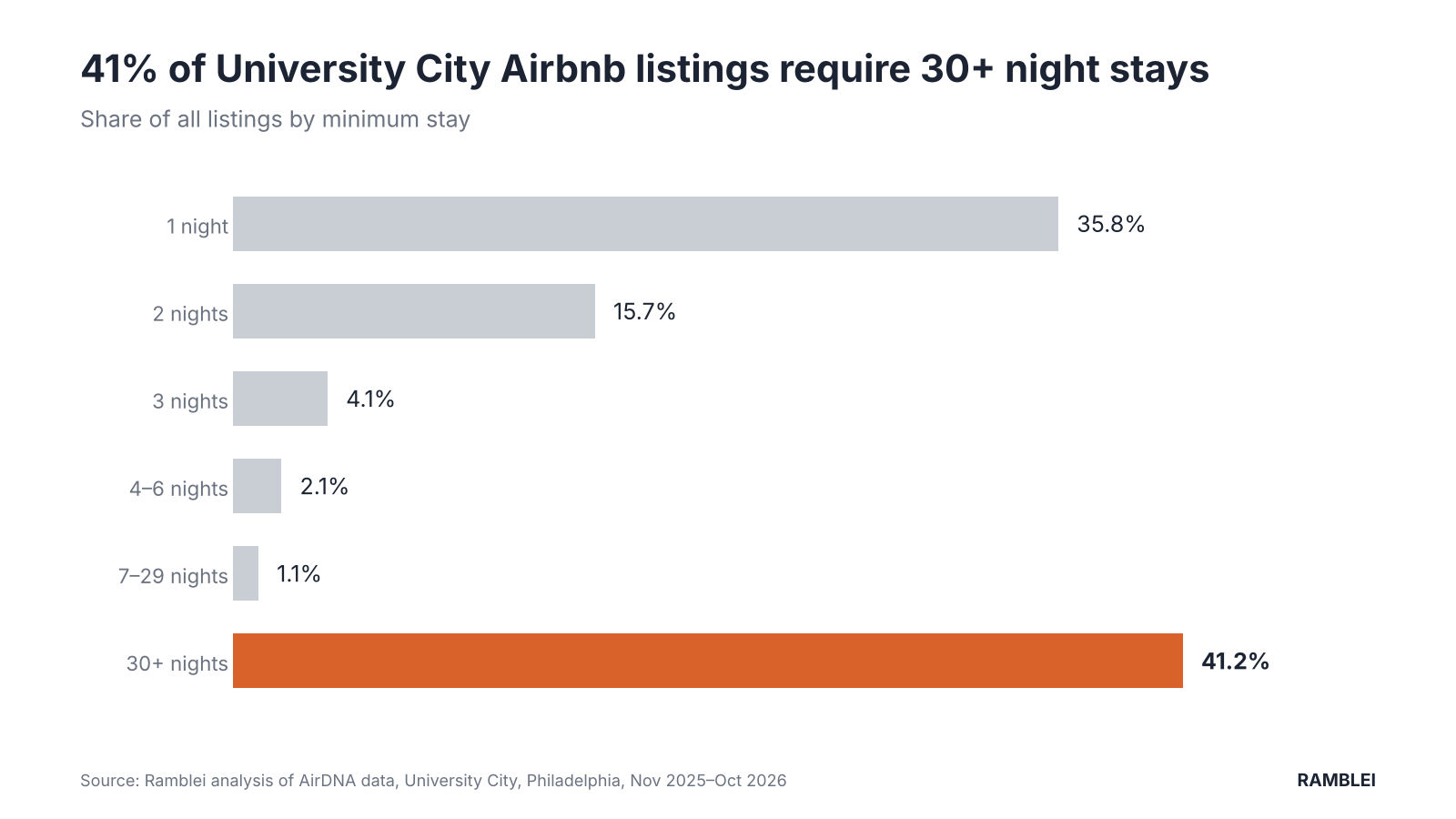
41.2% of University City Airbnb listings require a minimum stay of 30 nights or more. That's now the largest group, ahead of listings that allow 1-night stays (35.8%).
Among 1,155 studios, 1-bedrooms, 2-bedrooms, and private rooms that earned money in the past year, 505 (44%) accept only stays of 30+ nights.
Monthly rentals stay busy: year-round monthly units were booked for a median of 66% to 80% of available nights, with guests staying an average of 46 to 63 nights.
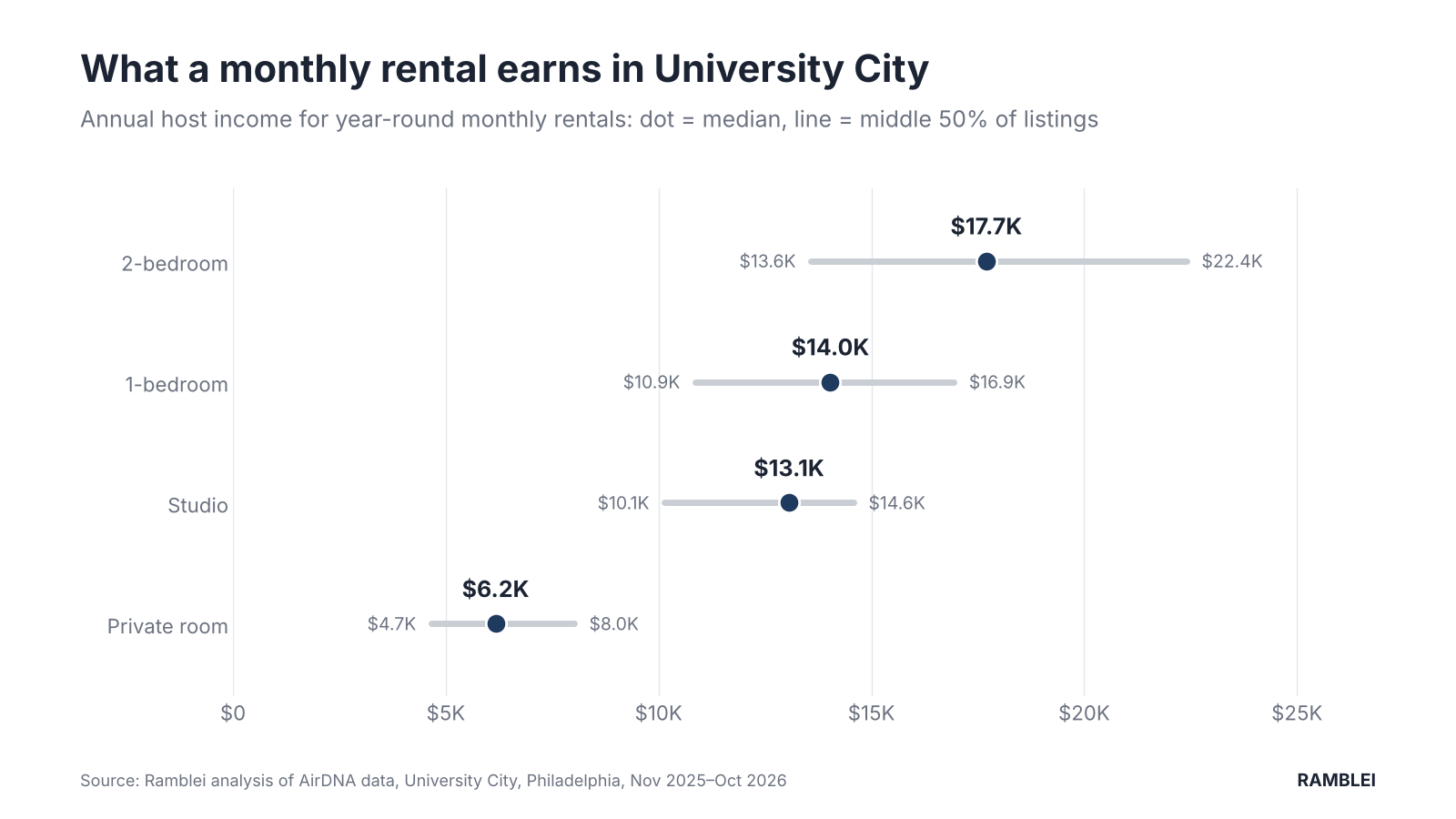
Median annual host income for year-round monthly rentals (after Airbnb's host service fee): about $14,000 for a 1-bedroom, $17,700 for a 2-bedroom, and $13,100 for a studio. By comparison, a year-round short-term 1-bedroom in the same area earned a median of about $20,500, but in Philadelphia that requires a short-term license and, for non-owner-occupied units, the right zoning.
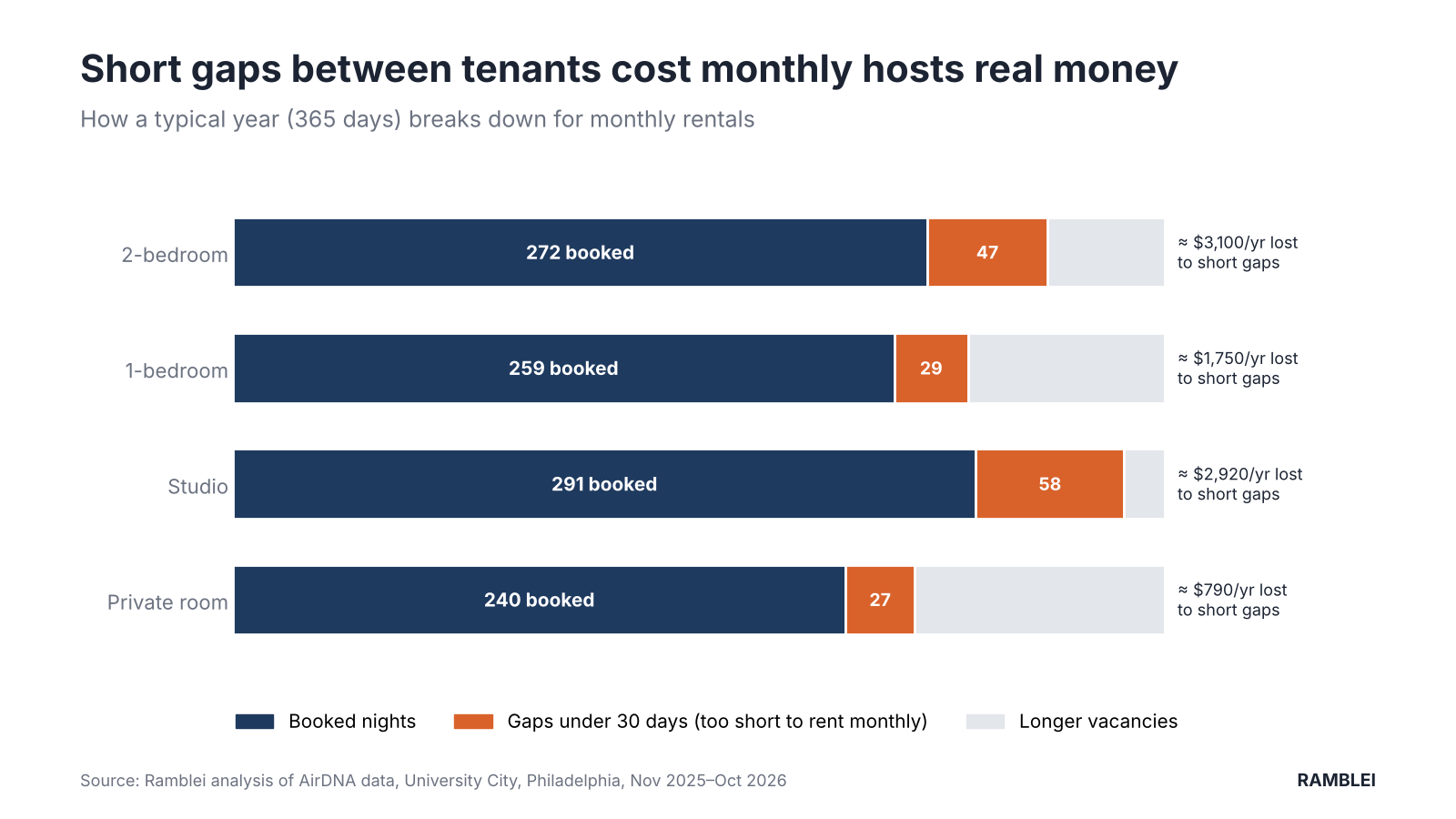
The biggest money leak is the gap between tenants. A 1-bedroom typically loses about 29 nights a year to gaps too short to rent monthly (around $1,750), and studios and 2-bedrooms lose about $2,900 to $3,100. Non-owner-occupied units can't legally fill those gaps with short stays without a short-term license.
The takeaway: a licensed short-term rental is now a scarce, high-earning asset. With 41% of University City listings locked into 30+ night stays, hosts who hold the right license compete with far fewer short-term listings. A year-round short-term 1-bedroom earned a median of about $20,500, roughly $6,500 more per year (about 46% more) than the same unit rented monthly.
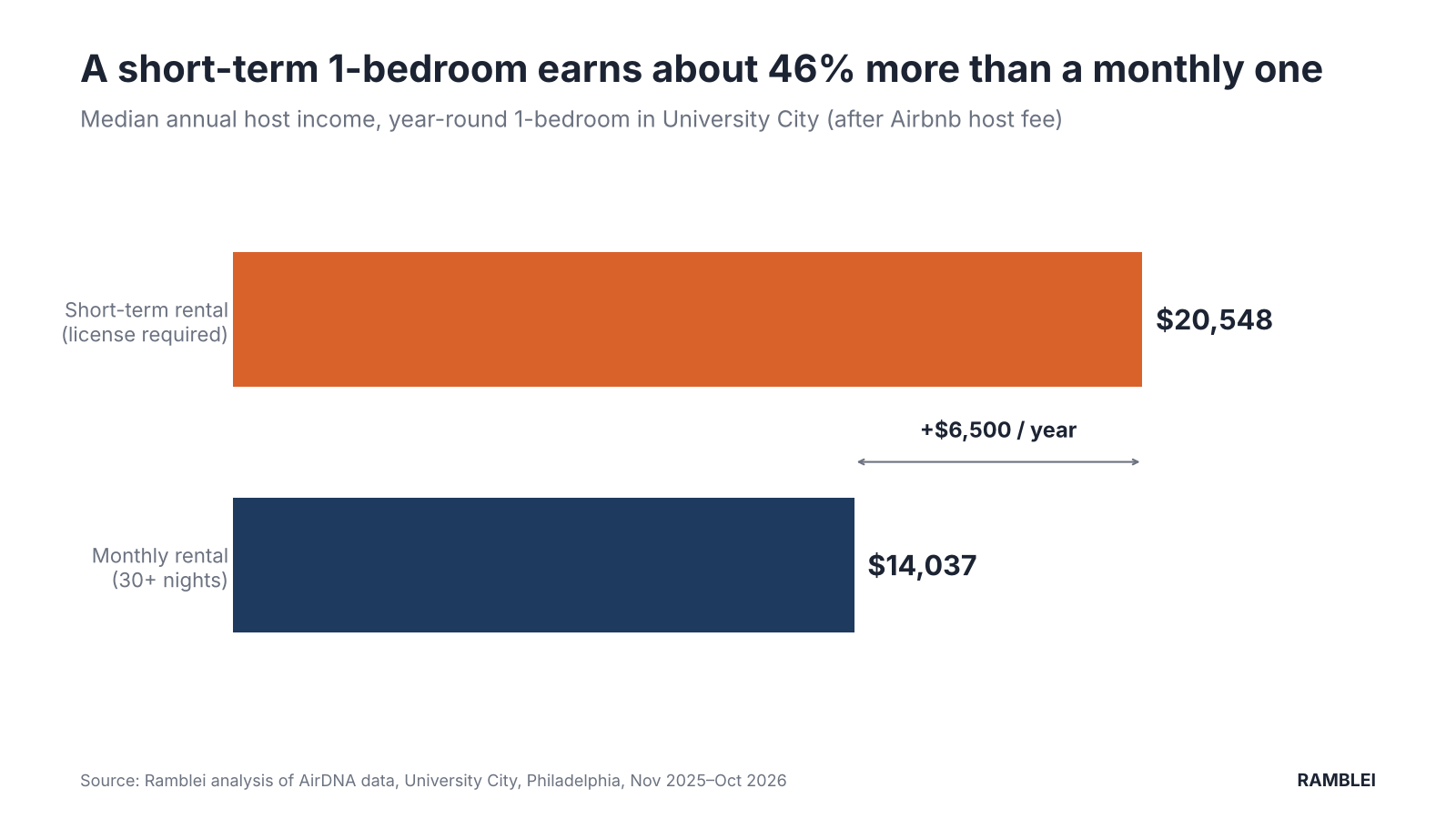
Source: Ramblei, University City Airbnb Monthly Rental Market Report, November 2026, based on AirDNA and Airbnb data. Income figures exclude management fees, utilities, cleaning, and repairs.
What this means for hosts: compliance now pays. Across Philadelphia, only about 1,000 properties hold a valid short-term rental license, while thousands of listings compete for the same guests. Every month, the City flags more unlicensed listings and pushes them into 30+ night stays, which leaves more short-stay demand for licensed hosts. If your property can be licensed, getting it done now puts you in one of the most profitable positions in the market. If it can't, a well-run monthly rental is still a steady, legal option.
Which license do you actually need?
Philadelphia treats any stay under 30 consecutive nights as a short-term rental, and the license depends on whether someone lives in the unit.
You rent your primary residence, or a room in it: you need a Limited Lodging Operator License. This is allowed in most residential areas. Fee: $150 per year (per Airbnb's Philadelphia page).
You rent a unit you don't live in: you need a Rental License with a hotel designation, plus a Visitor Accommodations zoning permit. This is allowed by right only in certain commercial districts (such as CMX-3, CMX-4, and CMX-5). Fee: $69 per unit per year (per Airbnb's Philadelphia page).
Both paths also require a Commercial Activity License, and hosts owe the City Hotel Tax. A regular long-term Rental License is not a short-term rental license, even though the numbers look similar.
Why listings get flagged, even with a license
Airbnb doesn't decide whether your license is valid. It passes your listing details to the City, and L&I matches them against its own records. Most rejections come from a mismatch:
Wrong license type. A regular long-term Rental License, or a hotel license whose record doesn't show the hotel category, won't verify for a non-owner-occupied short-term rental.
Wrong number. Entering your Commercial Activity License number, tax ID, or a number with letters or spaces instead of the rental license number.
Address or unit doesn't match. The listing address or unit number differs from the license record, or the license covers a different unit.
More listings than licensed units. A license for 2 units used on 6 room-by-room listings will not line up. Renting rooms separately in a unit with no resident host may also need L&I's guidance.
Name mismatch. The license is held by an LLC but the Airbnb account is in a personal name, or the reverse.
License not active. An expired renewal, unpaid fees, or open violations can leave a license inactive in the City's system.
Not sure which one applies to you? Ramblei checks your license and zoning for free and tells you exactly what's causing the mismatch. Get a free check or call (215) 268-6822.
What to do this week: a 5-step checklist
Look up your license. Search your license number in the City's eCLIPSE system (no login needed for search), or search your address in Atlas. Confirm three things: status is Active, the category is right for your situation, and the address and unit match your listing.
Check your zoning. If you don't live in the unit, enter your address in the City's Zoning Summary Generator and look for Visitor Accommodations under permitted uses. It is allowed by right only in certain commercial districts.
Fix your Airbnb listing details. Enter the rental license number (digits only), not your Commercial Activity License number. Use the exact address and unit on the license. Make sure the number of listings matches the number of licensed units.
Match the name. If an LLC holds the license, make sure the listing and payout account line up with that entity.
Contact L&I if the records are wrong. If your license is active and everything matches but the listing still fails, email L&I's short-term rental team with your license number, address, and a screenshot of the Airbnb notice, or call 311 (215-686-8686).
Rather not deal with L&I yourself? Ramblei handles the whole process: we look up your records, fix your listing details, and follow up with the City for you. Let us handle it.
If your property can't get a short-term license
Not every property qualifies, especially non-owner-occupied homes in residential zones. You still have options:
Mid-term rentals (30+ nights): furnished stays for travel nurses, visiting faculty, interns, and corporate guests. You need a regular Rental License, not a short-term license. Best for furnished units near hospitals and universities.
Long-term lease: a standard 12-month lease with a regular Rental License. Best for owners who want steady, low-touch income.
Zoning variance: apply to the Zoning Board of Adjustment to allow Visitor Accommodations. The outcome is never guaranteed. Best for properties near commercial corridors.
Stays of 30 consecutive nights or more fall outside Philadelphia's short-term rental definition, which is why mid-term rentals are the most common fallback.
Why Philadelphia hosts work with Ramblei
We're a local, Philadelphia-based team and a compliance-first property management company. We've worked through L&I license verification on our own properties, so we know exactly what the City checks and how to get listings back on track.
Fix a license problem: free license and zoning check; we correct your listing details and follow up with L&I.
Stay short-term: full-service Airbnb and VRBO management, including pricing, listing, guest communication, and turnovers.
Can't get a short-term license: we switch you to furnished mid-term rentals (travel nurses, visiting faculty, corporate stays) so income doesn't stop.
Need a zoning variance: we refer you to an attorney who handles Visitor Accommodations variances and keep you earning mid-term in the meantime.
Cleaning and repairs: in-house cleaning and handyman services for hosts who manage their own listings.
Someone nearby when things go wrong: we're a local Philadelphia team, so we can be on site for check-ins, cleanings, and repairs.
Get a free license and zoning check
Not sure whether your property qualifies? Send us your address and we'll check your license status and zoning for free, then tell you whether you can keep running short-term, need to fix something, or should switch to mid-term.
Get my free check · (215) 268-6822 · management@ydfortune.com
Frequently asked questions
Do I need a license to rent my home on Airbnb in Philadelphia?
Yes. Any stay under 30 consecutive nights in Philadelphia requires a short-term rental license: a Limited Lodging Operator License if it's your primary residence, or a Rental License with a hotel designation if it isn't.
Why did Airbnb say my Philadelphia license wasn't verified?
Airbnb reports every Philadelphia listing to L&I monthly, and the City matches it against its records. The most common causes are the wrong license type, entering a Commercial Activity License number instead of the rental license number, an address or unit mismatch, more listings than licensed units, or an inactive license.
Can I use a regular rental license for Airbnb in Philadelphia?
No. A regular long-term Rental License covers stays of 30 nights or more. Non-owner-occupied short-term rentals need a Rental License with a hotel designation and Visitor Accommodations zoning.
How often does Philadelphia check Airbnb licenses?
Monthly. L&I amended its regulations so booking platforms report listing data every month instead of every quarter.
What can I do if my Philadelphia property can't get a short-term rental license?
You can rent it mid-term (30+ nights) or long-term with a regular Rental License, or apply for a zoning variance if the property is near a commercial district.
How many Airbnb listings in University City, Philadelphia, are monthly rentals?
About 41% of University City Airbnb listings require a minimum stay of 30 nights or more, making monthly rentals the largest category in the area, according to Ramblei's November 2026 analysis of AirDNA data.
Who can help with Philadelphia Airbnb license problems?
Ramblei is a Philadelphia short-term rental management company that offers free license and zoning checks, helps hosts fix license mismatches, and manages short-term, mid-term, and long-term rentals.
About Ramblei
Ramblei is a compliance-first short-term rental management company based in Philadelphia, Pennsylvania. We manage short-term, mid-term, and long-term rentals across Philadelphia with a local team on the ground.
Services: Airbnb and VRBO management, license and zoning checks, help fixing license mismatches, mid-term rental placement, cleaning, and handyman services
Service area: Philadelphia neighborhoods including Center City, University City, Old City, Northern Liberties, Fishtown, and South Philadelphia, served by our local team
Contact: booking.ramblei.com · (215) 268-6822 · management@ydfortune.com · 1900 Washington Ave, Unit E, Philadelphia, PA 19146
Sources
Philadelphia L&I: Limited Lodging and Hotels Booking Agent transaction reporting (rev. Sept 2026)
Philadelphia City Controller: Short-Term Rentals in Philadelphia (June 2026)
AirROI: Philadelphia Airbnb rules and market data (Oct 2026)
Axios Philadelphia: More than a third of Philly Airbnb listings lack valid licenses (June 2026)
Philadelphia Inquirer: Was the World Cup good for Philly's economy? (Aug 2026)
This article is general information, not legal advice. Last updated: November 2026.